DDAO Engine™ · pure distillate
Real-time optimisation.
The Dedicated Dynamic Adaptive Optimization Engine is the software brain of the NAVODI.ME network, developed by our team: maximum rover stability in the field, even with critically poor mobile internet.
- DDedicated
- Optimised RTK VRS RTCM 3.2 corrections are broadcast to each individual device, at every moment.
- DDynamic
- The correction rate adapts in real time to the needs of the device and the working conditions.
- AAdaptive
- Recognises your rover's profile and sends only what its hardware supports.
- OOptimization
- Distils frequencies and satellites, takes geometry (DOP) into account and unloads the rover's processor.
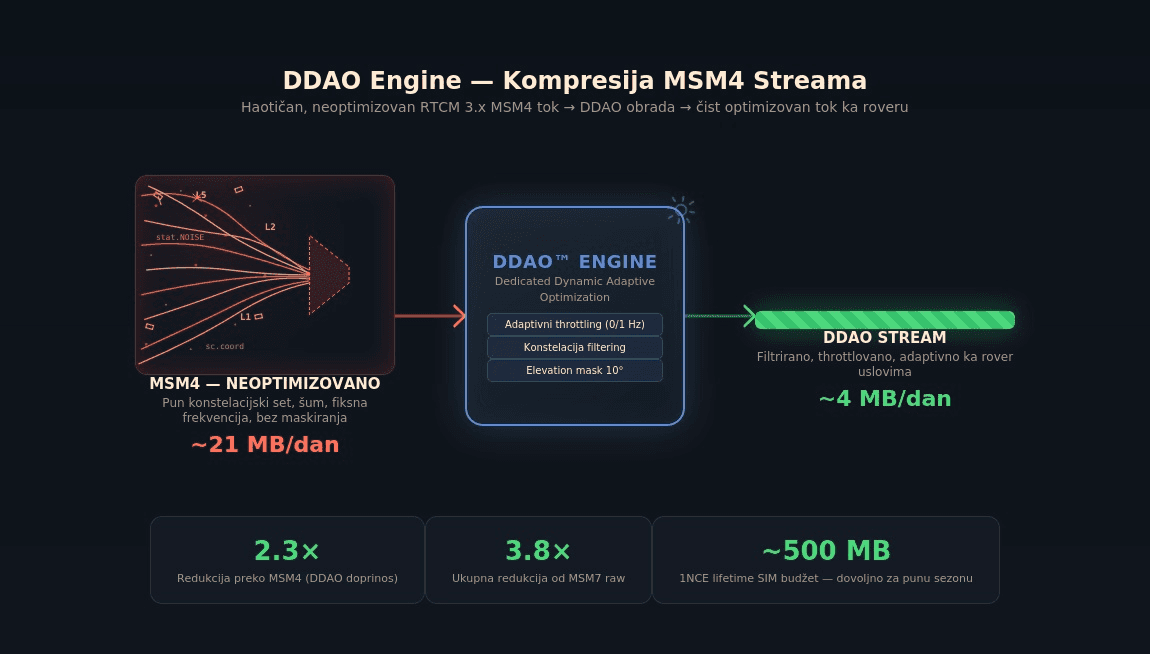
MSM4 stream compression
From 21 MB down to 4 MB a day.
An unoptimised MSM4 stream carries the full set of constellations, noise and a fixed rate. DDAO sends only what the rover actually uses.
- What is DDAO Engine™?
- An intelligent layer between the VRS caster and the rover's GNSS receiver that optimises correction data in real time.
- How does it work?
- Multi-layer signal optimisation in real time, tailored to every rover, the satellites and local conditions.
- What makes it unique?
- Instead of one universal signal, every rover receives personalised corrections.
Benefits
- Personalised corrections
- Every rover receives a signal optimised for its profile.
- Compatibility
- Standard RTCM 3.2 MSM4 – works with all GNSS receivers that support NTRIP.
- Efficiency
- Lower bandwidth and faster convergence; 2 cm precision with less processing, so the receiver runs cooler.
- Gets through poor networks
- A clean stream and up to 80% smaller packets get through congested rural cell towers, even on 2G.
- Low latency
- Correction age under 1 s reduces rover “wandering” and “jerking” during guidance.
- Low costs
- Thins out non-critical data and keeps internet use within affordable IoT SIM tariffs.